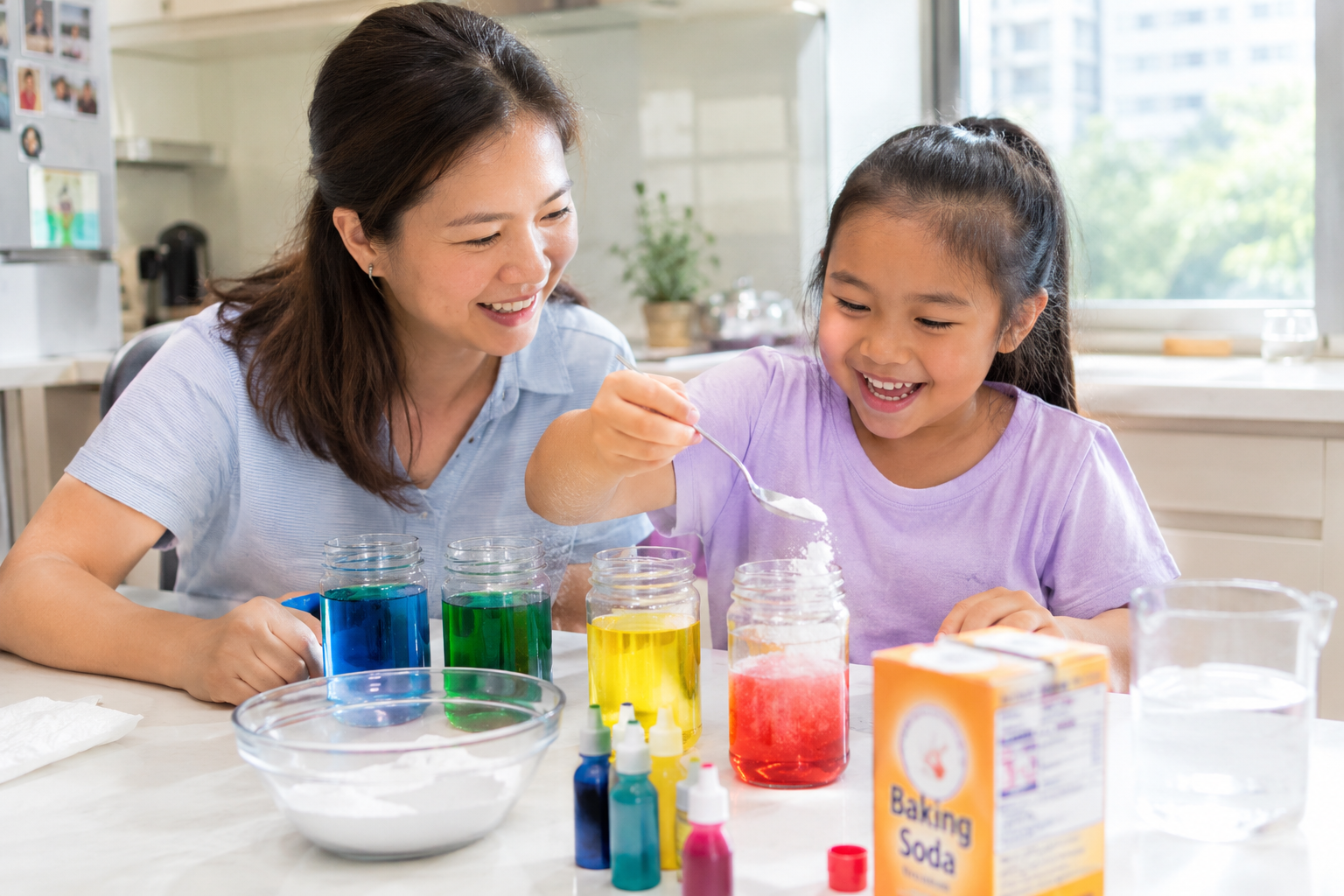
Children are naturally curious about how the world works, making interactive science experiments for kids one of the most effective ways to nurture a lifelong passion for discovery right in your own kitchen. When young learners observe bubbling liquids, changing colors, or sprout seeds on paper towels, abstract principles suddenly become vivid and memorable. At Wisdom Kids, we regularly see how practical discovery strengthens classroom understanding, reinforcing concepts taught in specialized primary science tuition classes across Singapore.
What You’ll Learn
- Why Hands-On Science at Home Matters for Primary Students
- 3 Simple and Safe Science Experiments for Kids to Try Today
- Connecting Home Exploration to Primary Science Tuition
- Practical Tips for Guiding Your Child’s Scientific Thinking
- Common Mistakes Parents Make During Home Experiments
- Expert Advice from Wisdom Kids Educators
- Conclusion
Why Hands-On Science at Home Matters for Primary Students
In the primary school syllabus, students transition from intuitive observations to formal inquiry skills, such as classifying, inferring, and analyzing experimental variables. Conducting simple experiments at home allows children to apply these processing skills without the pressure of exams. When a child predicts what happens when oil and water mix, they practice formulating hypotheses—a foundational skill required in upper primary school assessments.
Furthermore, bridging theoretical knowledge with tangible experiences nurtures academic confidence across multiple subjects. For example, calculating measurements during experiments reinforces principles taught in primary maths tuition, while writing detailed lab notes or observations develops descriptive vocabulary emphasized in primary english tuition. Experiential learning creates interconnected neural pathways, helping students retain facts long after a lesson ends.
3 Simple and Safe Science Experiments for Kids to Try Today
You do not need an elaborate laboratory setup or dangerous chemicals to create meaningful learning moments. These three safe, low-mess activities use everyday household items to illustrate key syllabus concepts.
1. The Density Rainbow Tower
Concept Covered: Density, mass, and liquid interactions.
Materials Needed: Honey, dish soap, water (with food coloring), vegetable oil, rubbing alcohol, and a tall clear glass container.
Steps: Slowly pour equal amounts of each liquid into the center of the glass, starting with honey, followed by dish soap, colored water, vegetable oil, and finally rubbing alcohol. Instruct your child to pour gently along the side of the glass to prevent splashing.
The Science: Liquids have different masses per unit volume. Denser liquids like honey sink to the bottom, while lighter liquids like oil float on top. Ask your child to drop a small grape or plastic bead into the tower to see which layer catches it!
2. The Baking Soda and Vinegar Gas Cannon
Concept Covered: Chemical reactions, acid-base interactions, and state changes (solid/liquid to gas).
Materials Needed: Baking soda, white vinegar, a small plastic bottle, a balloon, and a funnel.
Steps: Fill the plastic bottle halfway with vinegar. Use the funnel to fill an uninflated balloon with two tablespoons of baking soda. Stretch the neck of the balloon over the bottle opening, then lift the balloon upright so the baking soda falls directly into the vinegar.
The Science: Mixing an acid (vinegar) with a base (baking soda) creates a chemical reaction that releases carbon dioxide gas. The gas expands, inflating the balloon. This activity visually demonstrates how unseen gases occupy space and exert pressure.
3. The Walking Water Experiment
Concept Covered: Capillary action, plant tissue transportation, and color mixing.
Materials Needed: 5 small transparent cups, paper towels, water, and red, yellow, and blue food coloring.
Steps: Line up 5 cups in a row. Fill cups 1, 3, and 5 with water, leaving cups 2 and 4 empty. Add red coloring to cup 1, yellow to cup 3, and blue to cup 5. Fold strips of paper towel to bridge between adjacent cups. Observe over 2 to 3 hours.
The Science: Water moves through tiny gaps in the paper towel fibers due to capillary action—the exact same mechanism plants use to draw water up from their roots to their leaves.
Connecting Home Exploration to Primary Science Tuition
While home activities provoke curiosity, structured guidance helps children organize their thoughts into clear exam answers. Enrolling your child in targeted primary science tuition ensures that their creative discoveries align directly with Singapore’s MOE curriculum framework. At Wisdom Kids, our tutors explicitly teach students how to identify independent and dependent variables, formulate accurate hypothesis statements, and avoid common technical phrasing errors in open-ended questions.
Practical Tips for Guiding Your Child’s Scientific Thinking
To maximize the educational value of home experiments, adopt an inquiring mindset rather than simply giving answers. Here are practical strategies to guide your child:
- Ask Open-Ended Questions: Instead of asking “Did the water move?”, ask “Why do you think the water level in the empty cup changed?”
- Encourage Prediction: Before adding vinegar or dropping an object, ask your child to write down or draw their prediction.
- Embrace Unexpected Results: If an experiment fails to produce the expected outcome, treat it as a discovery. Ask, “What variable might have altered our results?”
- Keep a Science Journal: Provide a dedicated notebook for sketching setups, recording measurements, and listing observations.
Common Mistakes Parents Make During Home Experiments
While home science should be enjoyable, parents frequently encounter pitfalls that inadvertently stifle learning:
1. Doing Everything for the Child: It is tempting to step in to avoid mess, but allowing children to pour, measure, and mix builds fine motor skills and personal ownership over the learning process.
2. Rushing to Explain the Answer: Giving immediate scientific answers prevents children from developing critical deduction skills. Give them time to ponder and formulate their own explanations first.
3. Focusing Solely on the ‘Magic’ Trick: Seeing a color change or a pop is fun, but without connecting the reaction back to underlying physical or biological principles, the educational value is lost.
Expert Advice from Wisdom Kids Educators
Our experienced educators in Hougang emphasize that scientific literacy is built through consistent curiosity and vocabulary application. When conducting experiments, encourage your child to use precise terminology—such as ‘evaporation’, ‘condensation’, ‘force’, or ‘density’—rather than generic words like ‘stuff’ or ‘disappearing’. If you’d like to learn more about our approach, feel free to read about us and discover how our personalized teaching methodology nurtures confident, inquisitive learners.
Conclusion
Engaging in simple science experiments for kids turns everyday household moments into enriching educational journeys. By sparking curiosity at home and pairing it with structured guidance through high-quality primary science tuition, you give your Primary 1–5 child the analytical mindset and confidence needed to excel academically.
Frequently Asked Questions
What age is best to start simple science experiments at home?
Children as young as 6 or 7 years old (Primary 1) benefit immensely from basic sensory and observational experiments. As they grow older, you can introduce quantitative measurements and control variables suited for Primary 3 to 5 science topics.
How do home science experiments help with PSLE Science preparation?
Home experiments strengthen conceptual understanding and spatial reasoning, which are essential for tackling open-ended questions in school assessments. Experiencing concepts firsthand helps students visualize and explain scientific phenomena accurately in exam conditions.
Do I need expensive equipment to do science experiments with my child?
Not at all. Most impactful primary science experiments utilize everyday kitchen supplies like vinegar, baking soda, water, food coloring, and dish soap. The focus should be on the scientific method and observation, not complex apparatus.
How does Wisdom Kids tuition integrate hands-on learning with the MOE syllabus?
At Wisdom Kids, our primary science tuition program blends practical inquiry with explicit technique training. We help students translate physical observations into precise keyword-focused exam answers aligned with the latest MOE guidelines.
Where is Wisdom Kids located and how can I enroll my child?
Wisdom Kids is located in Hougang, Singapore. You can visit our website or book a consultation directly to schedule a diagnostic session for Primary 1 to 5 students in English, Maths, or Science.
At Wisdom Kids in Hougang, our primary science tuition program helps children develop critical thinking and subject mastery through hands-on learning and personalized guidance for Primary 1 to 5 students.